

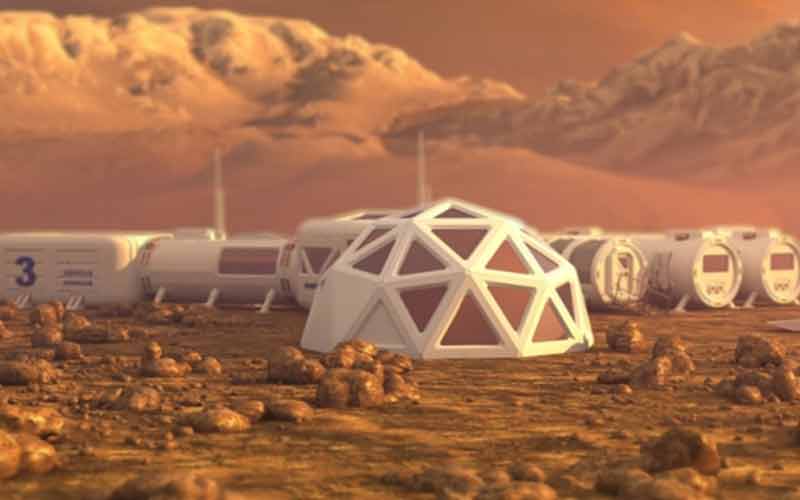
Life on Mars is an obvious source of inspiration for science fiction. It’s familiar and studied, yet different and far enough away to provide otherworldly adventures. NASA is on the Red Planet for these reasons. Future technology for Mars habitation is growing every day.
Robots for life on Mars
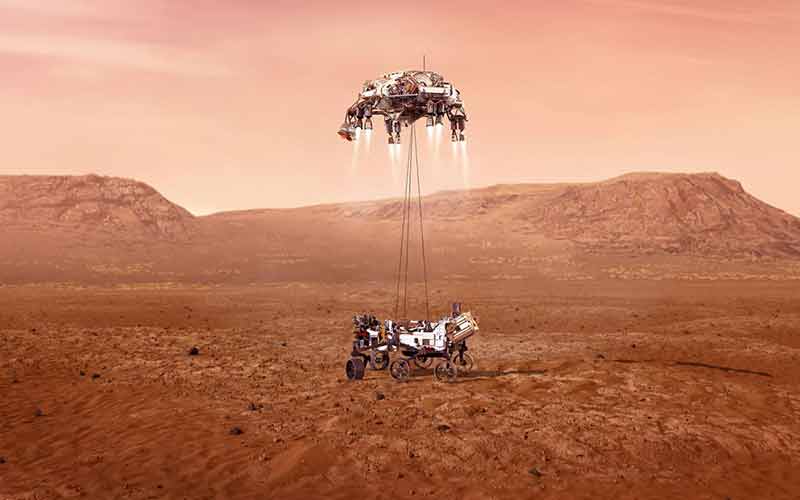
Robots, including the soon-to-be-launched Perseverance rover, are teaching us what the surface is like. This data will help inform future human missions to the Red Planet. We also need to equip spacecraft with new technologies to get them there, explore them, and easily bring them back home.
With future technology for Mars habitation, the round-trip mission, including transit time and return to Earth, would take about two years. Development of technology for living on Mars has already begun to make a crewed mission to Mars possible in the early 2030s.
Many capabilities will first be demonstrated on the Moon, during the Artemis missions, while other systems are uniquely suited to deeper space. Here are six technologies NASA is working on to make Mars science fiction a reality.
Powerful propulsion systems
Powerful propulsion systems are designed to get us to Mars faster. Astronauts heading to Mars will travel some 140 million miles into deep space. Advances in propulsion capabilities are key to getting there as quickly and safely as possible.
It’s unclear which propulsion system could take astronauts to Mars, but what is clear is that to reduce travel time, the spacecraft will need to be equipped with a nuclear system. NASA is exploring several options, including nuclear-electric and nuclear-thermal propulsion.
Both use nuclear fission but are very different from each other. In fact, a nuclear electric rocket can be more efficient. But it doesn’t produce much thrust. On the other hand, in considering future technology for Mars habitation, nuclear thermal propulsion provides much more “ohm”.
Inflatable heat shield for astronaut landings
The largest rover to land on Mars is about the size of a car. But sending humans to the planet would require much larger spacecraft. New technologies allow heavier spacecraft to enter the Martian atmosphere, approach the surface, and land close to where astronauts want to explore.
Future technology for habitation on Mars
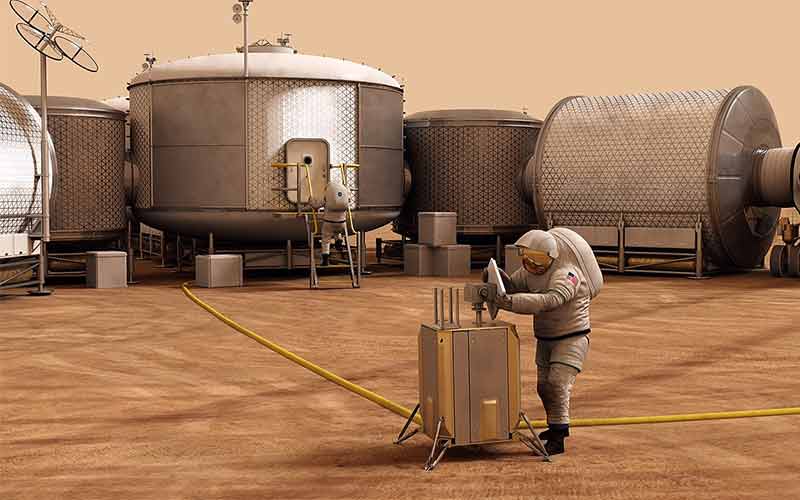
The future technology for Mars habitation is the Mars spacesuit, which is essentially a custom-made spacecraft for astronauts. The latest spacesuit developed by NASA is advanced and built in a modular design to accommodate the necessary evolutions for any point in space.
The first man and woman on the Moon will wear NASA’s next-generation spacesuits, called the Extravehicular Mobility Unit, or xEMU, in preparation for life on Mars. You can follow the latest technology news on Rebin Web.