

5G and 6G internet are among the higher-speed communications that will be available in many countries today. In this fifth-generation network, 5G has barely been commercialized and only a few places are enjoying its unique benefits. Meanwhile, researchers have taken a step forward in researching the wireless technology of the future. Still in the research phase, the 6G network could offer speeds of 1 terabit per second, or 8,000 gigabits per second, which will provide superfast connectivity.
Application of 5G and 6G Internet
As an example of the use of 5G and 6G internet, Netflix streaming requires 56 gigabits of data per hour to view the best quality video, and using the 6G mobile network, you can download 142 hours of Netflix quality video per second.
This high-level data processing capacity has the potential to bring new dimensions to the technological age with new applications and services that will completely change the lives and work processes of consumers and companies that use it to take advantage of the latest technologies of the day.
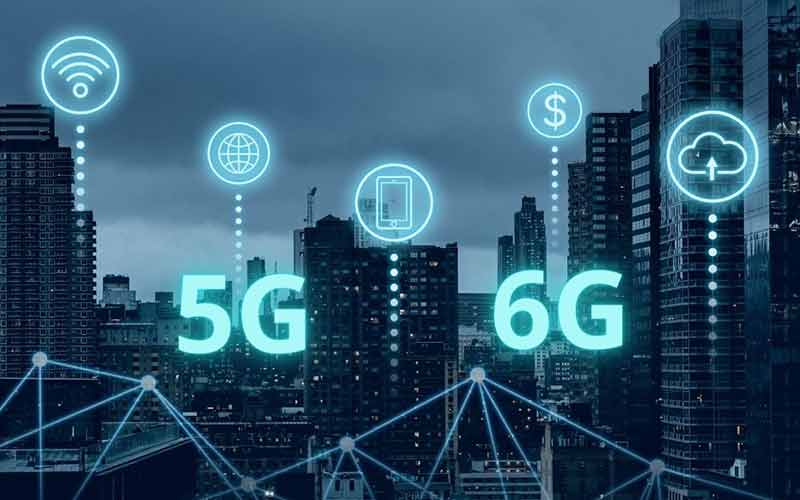
The difference between 5G and 6G high-speed communication networks
In examining the differences between 5G and 6G high-speed communication networks, it can be said that these networks use higher-range wireless spectrum to transmit data faster than 4G, 3G, and 2G networks. However, when comparing 5G vs. 6G, the former is allocated for low-band and high-band frequencies, below 6 gigahertz (GHz) and above 24.25 GHz, respectively.
The latter will operate in the frequency range of 95 GHz to 3 terahertz (THz). Since different spectrums are used, 5G and 6G internet technologies are pitted against each other, and 5G could have multiple use cases for different industrial sectors to increase their efficiency.
6G technology is faster than 5G
It can be said that 6G is faster than 5G technology. Considering the performance factor, 6G helps in higher performance which is much better than the new 5G wireless networks. Operating in terahertz frequency bands, 6G offers a maximum data rate of 1000 Gbps with air latency of less than 100 microseconds.
When we talk about 5G and 6G internet network speeds, 6G speeds are expected to be a hundred times faster than 5G with increased reliability and wider network coverage.

High-speed communication in the Internet of Things
High-speed communication in the Internet of Things is different in these two networks. The Internet of Things (IoT) has become a reality today with the implementation of 5G-based solutions, which was not possible with previous networks such as 4G due to poor planning of the frequencies applied.
The frequencies used to transmit the data required by smart devices were too crowded to achieve the desired results. This is where 5G bridges the gap and moving forward with 6G, we expect to connect more devices per square kilometer with the help of 5G and 6G internet as the number of connected devices increases in the coming years.